
The request usually sounds simple: one video for each week of the course, filmed whenever the instructor is free. Twelve weeks, twelve videos. Then the series gets produced like twelve separate projects, and by module seven the instructor has a new haircut, the title graphics use a different font, and module three points to a textbook edition the department has since dropped.
A course series isn’t twelve videos. It’s a system, and it either gets designed as one up front or patched together in the edit, one inconsistency at a time.
That’s the real job of educational video production services: turning a course outline into modules that look like they belong together, teach one thing each, and survive the next curriculum revision without a reshoot. None of that is settled on set. Most series that go wrong went wrong in week one of pre-production, when nobody agreed on what module nine would look like.
Scope the Series, Not the Video:
Start with learning objectives, not syllabus weeks: one objective per module, even if a week becomes three short modules. In a 2014 study of 6.9 million edX viewing sessions, Guo, Kim, and Rubin found median engagement topped out around six minutes, however long the video ran. That argues against filming the hour-long lecture and hoping.
Some educational video companies quote per finished video. For a series, ask them to scope the whole thing (module count, length range, what stays fixed) and to walk you through a multi-part education series they’ve already delivered.
Instructional Design Happens Before the Script:
Turn objectives into on-screen actions
“Students will understand dosage calculation” can’t be filmed. “Students will watch a nurse convert milligrams to milliliters, then try one” can. An objective without a visible action isn’t ready for a script.
Put the knowledge check after the hardest concept
A question belongs right after the concept learners most often get wrong, not at the end.
Choose the format by what the learner needs to see
- On-camera instructor for context, judgment, and motivation
- Screen capture for software, where the learner must copy clicks exactly
- Animation for anything invisible, from blood flow to cash flow
The same study has a caution for production budgets: a course filmed informally at an instructor’s desk held attention better than one shot in a professional TV studio. Clarity beats polish, which is why a good video production agency for education will ask for your objectives before your script, and why the instructional planning that happens in pre-production matters more than the camera package.
Shoot Twelve Modules in One Day:
Schedule by camera setup, not module order: film every segment with the same framing back to back, then reset the lights once.
- Block scheduling: all intros and outros together, then all demonstrations
- Wardrobe continuity: two outfits, both photographed, no fine patterns that shimmer on camera
- A graphics system built once: title cards, lower thirds, and callouts as templates, so module twelve matches module one
Skip the word-for-word teleprompter; most experts sound more natural from bullet points.
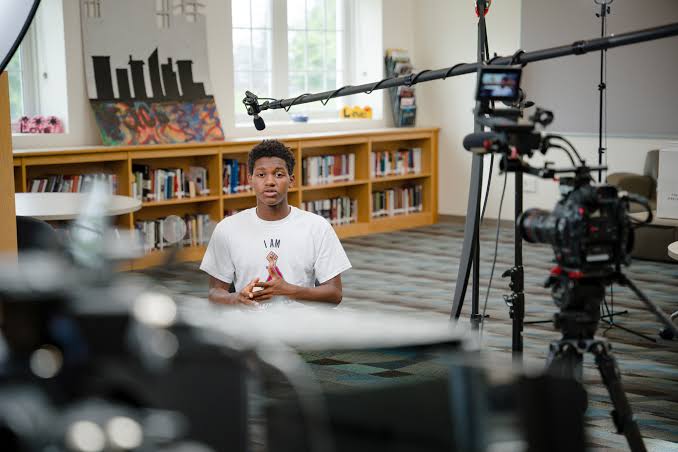
This is where an experienced educational video production company saves real money: on-camera footage for twelve modules from one well-planned day, instead of four scrambled ones.
What Your LMS Actually Needs:
eLearning video production companies should deliver more than an MP4. Ask for:
- Editable caption files (WebVTT or SRT), not burned-in text that needs a re-export to fix
- Human-checked captions. Automatic captions are often least reliable on the words a course exists to teach, like drug names and statistical terms.
- Transcripts, which double as a study guide
- Chapter markers at each concept, so learners can rewatch one idea
- File specs matched to your LMS
For public colleges and school districts, DOJ’s ADA Title II web rule requires WCAG 2.1 Level AA. Deadlines moved in 2026, so confirm yours.
Build Modules That Survive a Curriculum Change:
Curriculum changes. The question is whether that costs an edit or a reshoot. Keep anything likely to change off camera: dates, version numbers, and textbook editions belong in graphics or voiceover. Never have the instructor say a module number; courses get reordered, and “in module four” breaks the day someone moves it. Ask any educational video company how they’d handle a changed statistic in module nine. If the answer is “reshoot,” the series wasn’t built modularly.
Frequently Asked Questions:
Q1. Can our instructional designers handle video on their own?
Your designers own the learning. An eLearning video production agency owns how it translates to camera. The best projects pair them early.
Q2. Can we reuse our old lecture recordings?
As raw material, sometimes. In the same edX study, lectures filmed with online learners in mind held attention better than classroom recordings adapted afterward.
Q3. What should we prepare before kickoff?
Objectives, the course outline, LMS requirements, and an expert with review time.
Final Thoughts:
The best course video isn’t the most polished. It teaches one thing clearly and can be updated next semester. When you compare education video production companies, ask how they’d scope a series, not just what a single video costs.