
In a busy clinic, a “quick question” is rarely quick. It turns into repeat calls, portal messages, and staff time spent re-explaining the same instructions in slightly different ways. That’s exactly where video production for healthcare can pull real weight, not as marketing, but as patient support that scales.
Well-made education videos help patients replay instructions at home, share them with family, and actually follow through when it matters. The momentum behind video is not guesswork: Wyzowl’s 2026 survey found 91% of businesses use video, and 93% of marketers say it’s an important part of their strategy.
What’s really driving call volume and missed steps:
Most post-visit communication is not about new symptoms. It’s about uncertainty: dosage timing, wound care steps, “is this normal?”, or what to do if a side effect shows up. When instructions are only spoken once, recall drops fast.
Adherence is the other half of the problem. The WHO report on long-term therapies notes that “some 50% of medicines are not taken as prescribed.”That gap shows up downstream as avoidable complications, extra visits, and frustrated patients who feel like they “did everything right” but missed one key step.
How patient education videos reduce calls (and clinician workload):
The best patient education videos don’t try to replace care. They remove the predictable friction points that create calls.
A practical example: a quality improvement project in a community pediatric neurology clinic tracked after-visit communications and implemented interventions that included synchronous and asynchronous education. After the changes, average monthly call volume fell 30% (from 293 calls to 203), and the improvement held for at least a year. That study wasn’t “about video” specifically, but it supports a simple idea: when education becomes easier to access and repeat, call volume can drop. Video is one of the most scalable ways to deliver that repeatable education consistently.
This aligns with broader trends in video effectiveness. Wyzowl’s 2026 data shows 93% of video marketers say video increases user understanding, and 57% say it helped reduce support queries. “Support queries” is not the same as “clinic calls,” but the behavioral pattern is similar: clearer guidance upfront means fewer questions later.
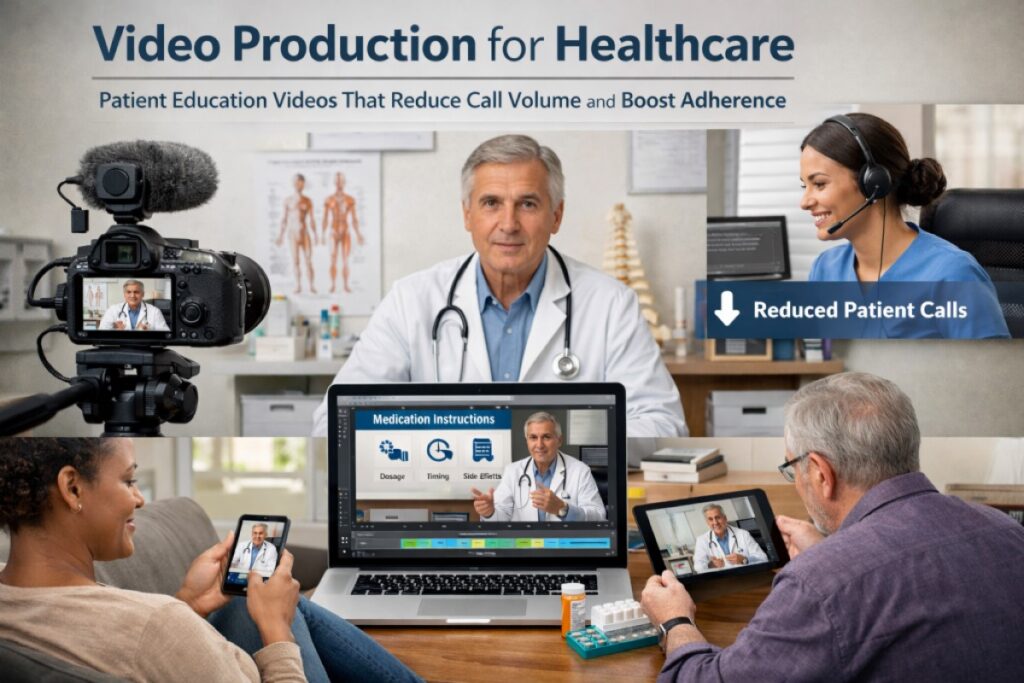
Formats that work in real clinics:
Healthcare videos work best when they’re built around moments that reliably generate confusion. A few high-impact formats:
“What to expect” videos for procedures (before, day-of, recovery timeline)
Medication walk-throughs (how to take it, common side effects, when to call)
Discharge instruction recaps (especially for ED or same-day surgery)
Chronic care self-management (asthma, diabetes, heart failure routines)
Physical therapy home exercises with form cues and common mistakes
The evidence base is encouraging for education outcomes. A 2023 systematic review in the Journal of Medical Internet Research found video-based tools were most effective for improving patient knowledge, with 75% of knowledge outcomes improved (30 out of 40).Knowledge alone does not guarantee behavior change, but it removes a major barrier: patients can’t follow instructions they didn’t fully understand.
What “professional” looks like in medical video production:
Strong medical video production is less about fancy visuals and more about precision: message clarity, correct sequencing, and accessibility. A full-service team typically supports four stages (Elephant Productions lays these out clearly on their services page):
Pre-production (where accuracy is won): planning the creative approach, script, instructional design, interactive elements, casting, and location scouting. Elephant Productions In healthcare, this is also where clinical reviewers and compliance stakeholders should be brought in early, not after filming.
Production: capturing interviews, demonstrations, or documentary-style footage depending on the message and audience. For Austin-area providers, this might mean mixing clinic footage with simple at-home demonstrations that match how patients will actually use the instructions.
Post-production: editing plus motion graphics, 3D animation, and even medical illustrations that make technical content easier to grasp, along with color correction and sound mixing. This is often the difference between “nice video” and truly usable education.
Delivery and distribution: planning around where the video will live (website, patient portal, YouTube, waiting room screens) because platform shapes length, pacing, and technical specs.
This is the backbone of effective healthcare video production: instructional clarity first, creative second, and distribution planned from day one.
Best practices for accuracy, trust, and accessibility:
To earn trust (and reduce legal and reputational risk), keep the build disciplined:
Script in plain language, then validate with a clinician reviewer and a patient advocate.
Use on-screen step markers (Step 1, Step 2) for anything procedural.
Add captions and make sure audio is clean. Many patients will watch without sound, or with hearing limitations.
Design for replay: keep most videos in the 30-second to 2-minute range when possible. Wyzowl found 71% believe that window is most effective.
Include “when to call” guidance to prevent unsafe self-triage.
If you serve multilingual populations in Austin, consider versions in Spanish and keep medical terms consistent across languages.
Measuring impact in Austin healthcare teams:
If the goal is fewer calls and better adherence, treat videos like operational tools and measure them like one:
Call volume by topic (before vs after the video rollout)
Portal message volume and common tags
No-show rate for prep-dependent appointments (imaging, procedures)
Medication refill timing or adherence proxies (when available)
Patient satisfaction and “instructions were clear” survey responses
Video completion rate and replays (often a clue that a step is confusing)
This is where video production for healthcare becomes a systems play. You are not “making content.” You are removing repeat work, improving consistency, and helping patients succeed at home.
FAQs:
Q1) What types of patient education videos reduce call volume the fastest?
Start with the top 10 call drivers: medication instructions, side effects, post-procedure care, and “when to call” guidance. Short, specific patient education videos tied to real questions typically outperform broad overviews.
Q2) How long should a healthcare education video be?
Aim for 30 seconds to 2 minutes for single-topic videos, and break complex topics into a short series. This matches what most viewers find most effective.
Q3) Do videos actually improve adherence, or just awareness?
Evidence is strongest for knowledge gains. A large systematic review found video-based tools improved patient knowledge in 75% of knowledge outcomes studied. For adherence, videos work best when paired with reminders, follow-up prompts, or simple checklists.
Q4) How do I create effective medical videos for marketing?
Create effective medical videos by focusing on clear, accurate information, patient trust, and simple messaging that speaks to real healthcare concerns. Use healthcare education videos to explain treatments, procedures, or preventive care in a way that feels easy to understand and credible. Strong medical video production should also include professional visuals, expert voices, and a clear call to action so viewers know what to do next.
Q5) What should I consider when choosing a healthcare video production company?
When choosing a healthcare video production company, look for experience in creating accurate, trustworthy, and engaging patient education videos. A strong medical video production partner should understand compliance, simplify complex topics, and produce content that feels professional and easy for patients to follow. Also review their past work to make sure their style matches your brand and audience.
Final Thoughts:
The smartest healthcare education videos feel almost boring in the best way. They are clear, specific, and built around the exact moments patients get stuck. When you treat video as patient support infrastructure, you can reduce repeat calls, improve confidence at home, and help more people follow the plan the first time.