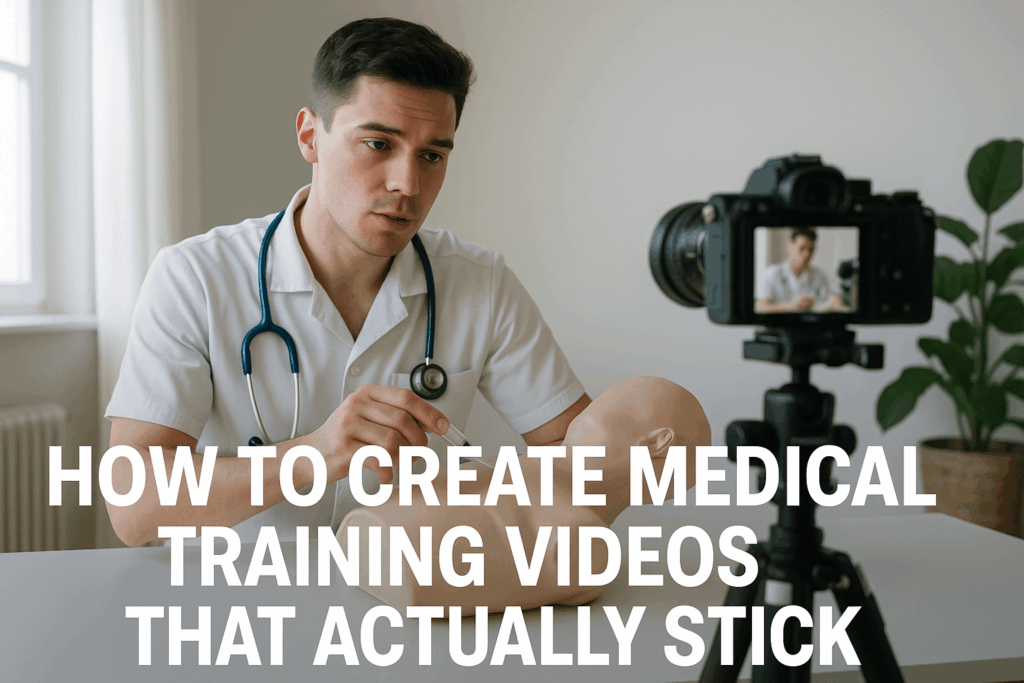
What the Top Hospitals, Schools, and Health Systems Get Right—And How You Can Too
If your medical training videos look good—but fail to improve staff performance—you’re not alone. Most healthcare organizations rely on outdated training formats or overproduced content that lacks instructional impact. The most effective medical video production doesn’t just explain procedures. They reduce onboarding time, improve patient care, and increase retention among clinicians.
Here’s how to create training videos that drive real learning outcomes and position your organization as a modern leader in healthcare education.
Step 1: Know Exactly Who You’re Talking To
Start by defining your viewer as precisely as possible. The tighter your focus, the stronger your impact.
Ask yourself:
- Are you speaking to experienced RNs, new hires, residents, or med students?
- Do they need a protocol refresher or a full procedural walkthrough?
- What’s their baseline knowledge—and what’s critical to communicate?
Pro Tip: Create audience personas and tailor content to their environment, skill level, and real-world needs.
Step 2: Design for Outcomes, Not Just Information
Most ineffective training videos fail because they dump information without a learning strategy. Effective instructional design for medical videos ensures better results:
- Set one clear outcome per video.
- Chunk the process: Break complex tasks into short, digestible modules.
- Use visual-first explanations: Demonstrate procedures instead of just describing them.
Studies show that outcome-focused, segmented videos increase retention and reduce training time across clinical settings.
FAQ: Optimal Length for Medical Training Videos?
Research consistently shows optimal video length is between 5 to 10 minutes. Break longer topics into standalone pieces for easier updates and faster learning.
Step 3: Make Visuals and Sound Work Harder
High-quality visuals are essential in medical video production, but it’s how you use them that makes the difference.
What top training videos include:
- Animations to simplify multi-step processes and concepts.
- Real-life scenarios to show procedures in action.
- Clean, focused voiceovers that guide without overwhelming.
Use professional narration and light background audio to hold attention without distraction.
Step 4: Build Interactivity Into the Experience
Even small interactive moments drive major gains in engagement and learning. Incorporating these healthcare training video tips can enhance viewer interaction:
Examples:
- End-of-module questions
- Reflection prompts (“What would you do next?”)
- On-screen checklists or step reviews
FAQ: Should Medical Training Videos Include Interactive Elements?
Absolutely. Integrating interactive quizzes and reflection pauses has proven highly effective, boosting engagement significantly.
Step 5: Validate Accuracy and Maintain Compliance
Accuracy isn’t optional. It’s fundamental.
Every piece of content should:
- Be reviewed by licensed professionals
- Align with the latest protocols and compliance standards
- Include clear disclaimers and version control
This protects your brand—and builds trust with your audience.
FAQ:
How do you create a medical training video that improves staff performance?
A: Creating a medical training video that actually improves staff performance starts with one non-negotiable rule: define a single, measurable outcome before a single frame is planned. Not “teach nurses about medication safety”—but “reduce medication labeling errors in the ICU by 25%.” That specificity drives every decision that follows. Structure the video around that outcome: open with why it matters to the clinician, demonstrate the correct technique in the real clinical environment (not a generic studio), and close with a clear checklist or quiz that confirms comprehension. Keep each module to 5–10 minutes and cover one procedure per clip—chunked content is easier to update and far easier to retain. Use high-quality close-up footage for critical steps like line placement, specimen labeling, or instrument orientation, where a blurry shot creates ambiguity that leads to errors. Pair live-action demonstrations with motion graphic overlays that highlight the exact step being performed. Finally, route the script through a licensed clinical reviewer before filming—accuracy is what separates a trusted training asset from a liability. A professional healthcare video production firm handles all of this: scripting with SMEs, HIPAA-compliant filming, clinical-grade post-production, and LMS-ready delivery.
What makes healthcare video production different from standard corporate video?
A: Healthcare video production differs from standard corporate video in four fundamental ways: accuracy requirements, compliance constraints, filming environment complexity, and the stakes of getting it wrong. In a brand video, a misworded line can be reshot. In a clinical training video, a misworded instruction can contribute to a patient harm event—which is why every script must be reviewed by licensed professionals before a camera rolls and why version control and compliance documentation are not optional extras. Filming inside active clinical environments—hospital floors, labs, surgical suites, and pharmacies—requires HIPAA-aware shot lists, signed patient and staff releases, quiet windows planned around care schedules, and crews who understand infection control protocols. Standard corporate video crews are rarely equipped for this. Production itself demands a different visual language: macro lenses to capture small but critical details like line colors, barcode placement, and instrument orientation; controlled lighting that removes ambiguity from procedural steps; and clean audio that carries verbal instructions clearly. In post-production, motion graphics and medical illustration replace the decorative animations typical in brand work—every callout exists to eliminate confusion, not to look impressive. The payoff is measurable: well-produced healthcare video improves clinical knowledge and skills, reduces onboarding time, and supports the kind of standardized, audit-ready training that patient safety frameworks require.
When should medical training videos use animation instead of live-action footage?
A: Medical training videos should use animation when the key learning moment happens somewhere a camera cannot go—inside the body, inside a device, or inside a molecular process. Animation is the right choice for explaining mechanisms of action, visualizing drug pathways, demonstrating what happens during a central-line insertion at the vascular level, or showing the internal steps of a device that cannot be safely opened on camera. It is also the better choice when real-world footage would be too graphic, too variable across facilities, or too difficult to standardize—for example, sterile processing steps that look different in every SPD or de-escalation techniques that depend too heavily on a specific actor’s performance. Live-action is the stronger choice when learners need to see the exact physical movements, equipment, and environment they will encounter on shift—medication preparation at a specific Pyxis station, specimen labeling at the point of care, or a handoff using your organization’s actual EHR screens. The most effective medical training videos blend both: live-action establishes real-world context, animation reveals invisible steps, and motion graphic overlays connect the two by labeling key details in the live footage. A professional medical video production team evaluates this decision during pre-production—choosing the format that eliminates the most ambiguity for the specific learner and task, not the format that is cheapest or fastest to produce.
Final Takeaway: Don’t Just Train—Transform
Great training videos don’t just check a box—they change behavior. When done right, they create confident clinicians, improve patient safety, and reduce operational headaches.
If you’re building or improving your medical training library, focus on clarity, structure, and strategy—not just production value.
Want help producing training videos that meet clinical standards and actually get used? Let’s talk.