In today’s fast-paced healthcare landscape, effectively communicating complex medical information to patients is more crucial than ever. While traditional methods like brochures and lengthy consultations have their place, a modern approach is transforming patient understanding and engagement: storytelling through patient education videos.
This powerful medium, often seen in the form of healthcare explainer videos and medical animation videos, is not just about presenting facts; it’s about making information relatable, memorable, and actionable.
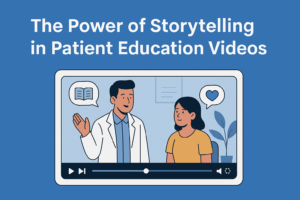
Why Storytelling Resonates in Healthcare
Humans are hardwired for stories. From ancient fables to modern blockbusters, narratives capture our attention, evoke emotions, and help us process information in a deeper, more meaningful way. In the context of patient education, storytelling offers several invaluable benefits:
-
- Simplifies Complexity: Medical jargon can be overwhelming. A well-crafted story can break down intricate procedures, conditions, or treatment plans into digestible, easy-to-understand segments. By following a character’s journey, patients can see themselves in the narrative, making abstract concepts concrete.
-
- Boosts Retention: Information presented as a story is far more likely to be remembered than a list of bullet points. The emotional connection forged through narrative helps cement key messages in the patient’s mind, leading to better recall and adherence to instructions.
-
- Reduces Anxiety: Facing a medical diagnosis or treatment can be daunting. Stories can demystify the process, offering reassurance by showing how others have navigated similar situations successfully. This empathetic approach can significantly reduce patient anxiety and foster a sense of hope.
-
- Empowers Patients: When patients understand their condition and treatment options clearly, they feel more in control and are better equipped to participate in their own care decisions. Storytelling empowers them by providing knowledge in an accessible format.
-
- Fosters Trust: A transparent and relatable narrative builds trust between healthcare providers and patients. When a video clearly explains what to expect, it demonstrates a commitment to patient well-being and open communication.
The Role of Explainer and Animation Videos
Healthcare explainer videos are adept at concisely communicating a specific concept or process, often using a blend of live-action and graphics. They can walk patients through pre-operative instructions, explain medication side effects, or illustrate the benefits of a new therapy.
Meanwhile, medical animation videos take storytelling to another level, especially for topics that are invisible to the naked eye. Through stunning visuals and dynamic sequences, animation can bring to life the intricate workings of the human body, the mechanism of action of a drug, or the progression of a disease. This visual clarity is unparalleled in helping patients grasp complex biological processes.
Companies like Elephant Productions leverage their expertise in healthcare video production to create informative videos that educate patients and promote practices. They understand how to distill complex medical information into engaging narratives that can be used online, in waiting rooms, or for staff training.
Crafting Impactful Patient Education Stories
Creating effective patient education videos requires more than just technical skill; it demands a deep understanding of the patient’s perspective. Key elements include:
-
- Relatable Characters: Whether animated or live-action, characters that resonate with the target audience make the story more personal.
-
- Clear Problem and Solution: A good narrative identifies a challenge (e.g., a medical symptom) and presents a clear path to resolution (e.g., a treatment).
-
- Emotional Arc: Even in educational content, a subtle emotional journey can make the information more impactful.
-
- Call to Action: Guiding patients on what to do next, whether it’s talking to their doctor, scheduling an appointment, or adopting a new habit.
FAQ:
Q1. Why is patient education important and how does video make it more effective?
A: Patient education is important because understanding a condition, treatment, or care plan is a prerequisite for following it. A patient who leaves a consultation confused about their medication schedule, discharge instructions, or post-operative care steps is at significantly higher risk of errors, avoidable readmissions, and poor outcomes—regardless of how technically excellent the clinical care was. The World Health Organization estimates that around half of prescribed medications are not taken as directed, and the root cause is rarely defiance—it is most often confusion, anxiety, or incomplete recall. Video makes patient education more effective for three compounding reasons. First, it pairs verbal explanation with matching visuals, which research on multimedia learning consistently shows improves comprehension and retention compared to text or speech alone. Second, it is repeatable—a patient can watch a discharge instruction video three times at home at 11pm, share it with a family caregiver, and pause on the exact step they are unsure about, none of which is possible with a verbal explanation in a busy clinic. Third, when built around storytelling—a real or representative patient navigating the same situation—it reduces anxiety by showing that others have faced this and come through it. Healthcare providers who embed video into the patient journey across pre-visit preparation, procedure explanation, and post-discharge follow-up see measurable improvements in adherence, satisfaction scores, and call volume reduction.
Q2. What are healthcare explainer videos and how do they help patients understand complex medical information?
A: Healthcare explainer videos are short, professionally produced videos that translate complex medical concepts—a diagnosis, a procedure, a treatment plan, or a medication—into clear, accessible language and visuals that patients can follow and remember. Unlike a clinical brochure or a verbal consultation, an explainer video combines narration, visual demonstration, and story structure to make abstract information concrete. A patient who has just been told they need a colonoscopy, for example, can watch a two-minute explainer that walks them through exactly what to expect before, during, and after the procedure—reducing anxiety, improving preparation compliance, and cutting the volume of follow-up calls to the clinic. The most effective healthcare explainer videos use one of two formats: live-action, which grounds the explanation in a real clinical environment and builds trust through human faces and familiar settings; or medical animation, which visualizes processes that happen inside the body or a device where a camera cannot go—like how a drug moves through the bloodstream or how a stent expands inside an artery. Many high-impact patient education videos blend both, using live action for context and animation for the invisible biological detail. The key to effectiveness is always the same: one clear message per video, plain-language narration written for a patient, not a clinician, and a call to action that tells the viewer exactly what to do next.
Q3. What should I consider when choosing a healthcare video production company?
A: When choosing a healthcare video production company, look for experience in medical content, compliance knowledge (like HIPAA), and a strong portfolio of patient-focused videos. Also consider their ability to communicate clearly, understand your audience, and deliver high-quality visuals within budget.
Q4. What are the latest trends in e-learning video production?
A: The latest trends in patient education videos include microlearning (short, focused videos), interactive content, and AI-driven personalization for better engagement. Animated explainers and mobile-first formats are also gaining traction to make complex information easier to understand.
Conclusion:
The integration of storytelling into patient education videos, through the engaging formats of healthcare explainer videos and medical animation videos, is transforming how patients learn and interact with healthcare information. By appealing to human empathy and cognitive processes, these videos do more than inform; they empower, reassure, and ultimately contribute to better health outcomes. For healthcare providers looking to enhance patient understanding and engagement, embracing the power of storytelling is not just an option—it’s an imperative.